A tight wrist can make ordinary moments feel unexpectedly demanding: holding a phone, typing a message, carrying a suitcase through Lisbon, or gripping a bar at the gym. If you are wondering how to ease wrist tension, the answer is rarely to stretch harder. Most wrists respond better to a calmer approach: less strain, more circulation, and enough attention to the muscles above and below the joint.
The wrist is small, but it is not working alone. Tension often begins in the fingers, forearms, shoulders, or even the way you sit. Treating the wrist with patience can restore a lighter, more natural feeling in the hand.
Start by noticing what your wrist is asking for
Wrist tension can feel like stiffness, a dull ache, gripping fatigue, or an uncomfortable pull when you bend the hand back. It is common after long hours at a laptop, travel days, strength training, cycling, gaming, or repetitive manual work. Stress can play a part as well. Many people tighten their hands without realizing it, especially while concentrating.
Before trying to release the area, notice when the discomfort appears. Is it strongest in the morning? Does it build after typing? Does one movement create a sharp sensation? Those details matter because relief should fit the pattern, not fight it.
Mild muscular tightness often improves with rest, movement, and careful bodywork. Sharp pain, significant swelling, numbness, tingling, weakness, loss of grip, or pain after a fall deserves medical assessment. Do not massage aggressively through symptoms that feel electric, unstable, or worsening.
How to ease wrist tension with gentle movement
The goal is not to force flexibility. The goal is to remind the hand and forearm that movement can feel safe again. Move slowly, breathe normally, and stop before discomfort becomes pain.
Release the fingers first
Open one hand wide, spreading the fingers softly, then make a loose fist. Repeat several times without squeezing. Follow by rotating each wrist in small, controlled circles in both directions.
This simple sequence is particularly useful after screen time. It gives the smaller muscles of the hand a chance to move without demanding a deep stretch from the joint.
Stretch the forearm, not only the wrist
Much of what feels like wrist tension comes from the forearm flexors and extensors. To address the palm-side muscles, extend one arm forward with the palm facing up. With the other hand, gently guide the fingers down toward the floor. Keep the elbow soft rather than locked.
For the top of the forearm, turn the palm down and lightly guide the hand toward you. Hold each position for 15 to 25 seconds while breathing slowly. One or two rounds are enough. A stretch should feel clear but controlled, never sharp.
If your wrists are sensitive, reduce the range of motion. Consistency is more valuable than intensity.
Add a little glide
With your elbow bent at your side, slowly turn the palm upward, then downward. Next, bend the wrist forward and back through a comfortable range. These small gliding movements can feel more restorative than a prolonged hold, especially when stiffness follows travel or a long working day.
Change the pressure that created the tension
A good stretch is useful, but it cannot fully compensate for hours spent in an awkward position. Look at the repeated habits around your hands.
At a desk, keep the keyboard close enough that you are not reaching. Let your shoulders stay relaxed and your elbows rest near your sides. Your wrists do not need to hover in a dramatic bend. A neutral, easy position is usually kinder than forcing the hands flat against the desk.
When using a phone, alternate hands and bring the screen closer to eye level when possible. Constant thumb scrolling with the wrist bent inward is a quiet source of fatigue. For training, check whether you are gripping more tightly than necessary. A firm hold has its place, but white-knuckling every set transfers unnecessary effort into the forearms.
Small pauses work well when they are realistic. Take 30 seconds between meetings to open and close the hands, roll the shoulders, and let the arms hang loosely. It is a discreet reset with a noticeable effect over a day.
Use warmth and self-massage thoughtfully
Warmth can help when the wrist and forearm feel stiff rather than inflamed. A warm shower, heated towel, or brief soak may make movement feel easier. If an area is newly swollen, hot, or irritated after overuse, a cool compress may be more comfortable instead. There is no single rule for every body, so pay attention to how the area responds.
For self-massage, begin in the forearm rather than pressing directly into the wrist joint. With the opposite hand, use slow thumb or finger pressure along the fleshy muscles below the elbow and toward the base of the palm. Work in small sections. Pause on tender areas, but do not dig hard.
You can also place the forearm on a table and slowly roll it over a soft massage ball. Keep the pressure moderate. If you feel tingling in the fingers or a sharp line of pain, stop and choose a gentler method.
The most effective touch often feels steady, warm, and unhurried. It encourages the nervous system to let go rather than defend itself.
Do not overlook the neck, shoulders, and chest
A tight wrist is sometimes the final link in a longer chain. Hours with the head forward, shoulders raised, and chest closed can create strain down the arm. This is especially familiar to business travelers working from hotel desks or answering messages between appointments.
Try standing tall, rolling the shoulders backward, and taking several slow breaths that expand the ribs. Gently turn your head side to side. Then repeat the hand-opening movements. When the upper body settles, the forearms often soften with it.
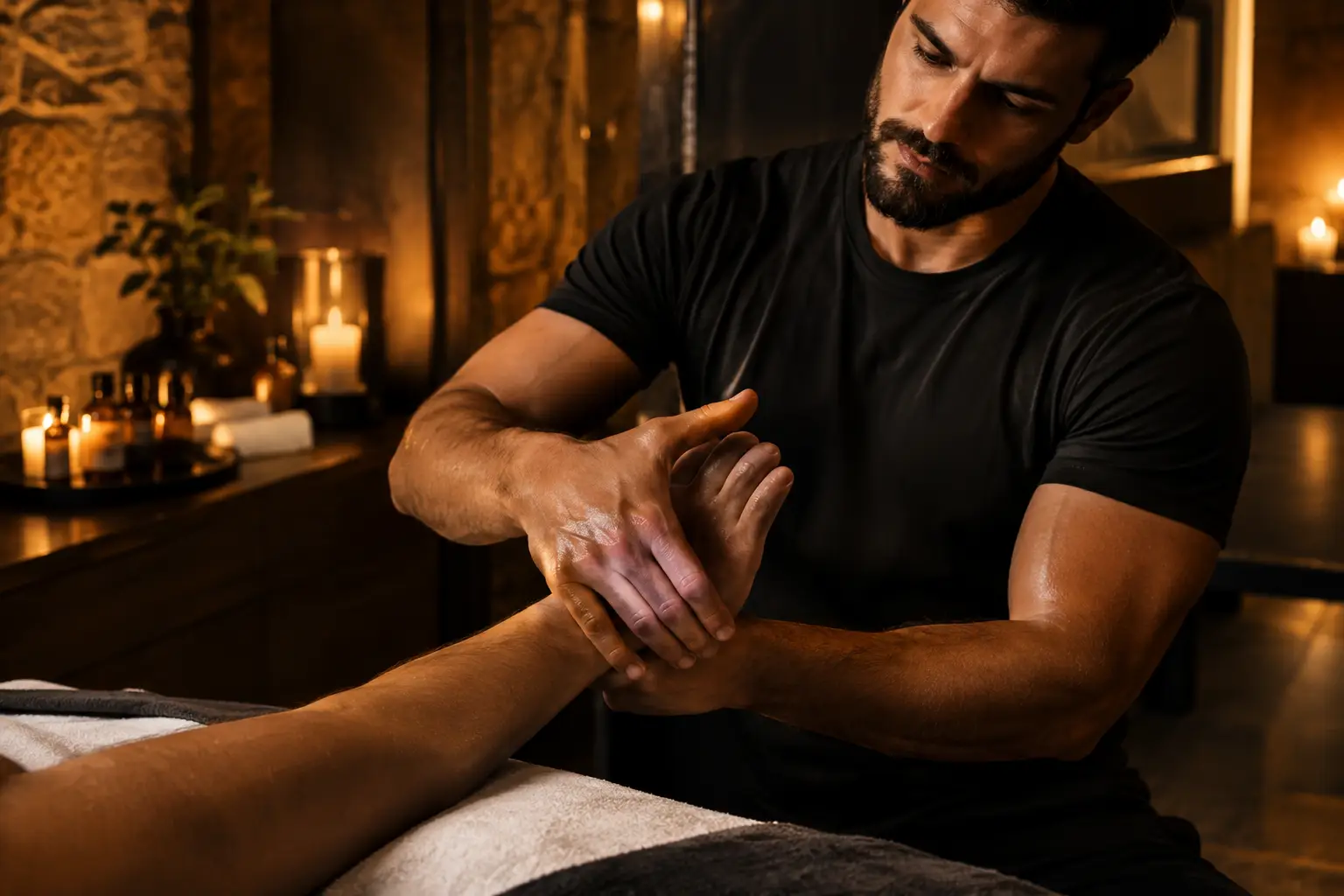
This is also why a well-considered massage session can be more helpful than focusing on one sore point. Skilled therapeutic massage can address the hands and forearms while also working through the shoulders, upper back, and chest that may be contributing to the holding pattern.
When professional massage makes sense
If your wrists feel chronically tired but you have no warning signs of injury, professional bodywork can provide a more complete reset. Deep tissue massage may suit men whose forearms are overworked from training, physical work, or repetitive movement. A sports-focused session can be appropriate when tightness is connected to a training routine. For stress-driven tension, a slower relaxation massage may be the better choice.
The right pressure depends on the day. More intensity is not automatically better. An experienced therapist should adjust to your comfort, your training load, and the quality of the tissue, especially around the delicate structures of the wrist.
At a private massage studio, the quiet itself can be part of the benefit. There is space to slow down, release the grip of a demanding schedule, and receive focused care without rushing back into noise. If you are visiting Lisbon or balancing a full calendar in the city, a personalized session can be a refined way to restore ease through the hands, arms, and shoulders.
Give your wrists a better rhythm
Wrist relief is usually built through repetition, not one dramatic intervention. A few minutes of movement before work, less gripping during the day, and a brief forearm release in the evening can change how your hands feel by the end of the week.
Be attentive without becoming anxious. Your wrists do a great deal for you, often quietly. Give them warmth, range, and recovery, and let the rest of the body soften with them.